Forex trading for beginners in 2026 explained as a structured course rather than random signals
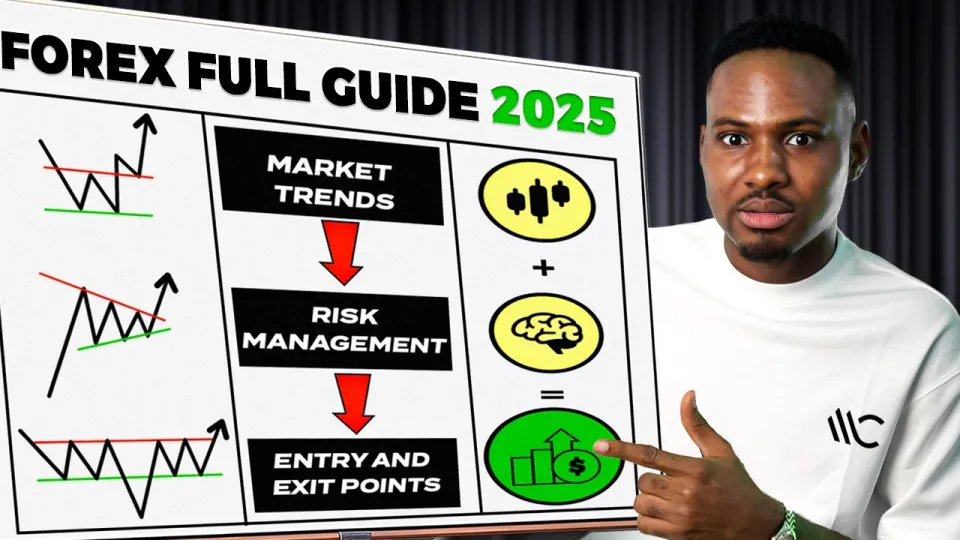
Video: How To Start Forex Trading For Beginners’ 2025 (Full Course)
Want articles like this for your own video to promote it on YouTube and Google? Order them through the Telegram bot @sat_sit_bot. It writes articles around your video, embeds the video and publishes them on popular niche websites (no ads). Free trial — 50 articles.
· based on the channel Jeffrey Benson Forex
Key takeaways
- Forex is a decentralised over-the-counter market where currencies are quoted in pairs; the EUR/USD spread is typically the tightest and most beginner-friendly.
- Four sessions dominate liquidity: Sydney, Tokyo, London and New York, with the London–New York overlap carrying the heaviest volume.
- A standard lot is 100,000 units; a mini lot is 10,000 and a micro lot is 1,000, which is why micro accounts suit first trades.
- Risk management comes before strategy: most beginner blow-ups trace to oversized positions, not bad analysis.
- A demo account plus a written trading journal are the two cheapest tools for converting lessons into skill.
Forex trading for beginners is best learned as a full course rather than a collection of tips: you start with what the market is, move to the tools and platform, then build one repeatable strategy and only afterwards place a first trade with real money. The structured curriculum in the "How To Start Forex Trading For Beginners' 2025 (Full Course)" walkthrough from the Jeffrey Benson Forex channel follows exactly that order, and students who want the paid track can review the programme options at Fire Pips FX plans.
What forex trading actually is and why beginners start here
Forex is the exchange of one currency for another at an agreed price, and everything else in the market is built on that single mechanic. Currencies are always quoted in pairs: the first currency is the base, the second is the quote, so a EUR/USD price of 1.0850 means one euro buys 1.0850 US dollars. When you buy the pair you are effectively long the euro and short the dollar; when you sell it, the reverse.
The market is decentralised and trades over the counter through a network of banks, brokers and liquidity providers rather than a single exchange. That structure produces three practical consequences for a beginner:
- Trading runs 24 hours a day from Sunday evening to Friday evening (UTC), so you can choose a session instead of being forced into one.
- There is no central volume tape; tick volume from your broker is a proxy, not the whole market.
- Your broker is your counterparty or your gateway to one, which makes regulation and execution quality a first-order decision, not an afterthought.
Major pairs such as EUR/USD, GBP/USD, USD/JPY and AUD/USD carry the deepest liquidity and the tightest spreads. Exotic pairs can look attractive because they move in wide ranges, but the wider spread and thinner depth punish beginners who size positions the same way they would on a major.
How the forex market moves through the four sessions
Liquidity is not constant, and the trading day is really four overlapping sessions that each behave differently. Knowing which session you are trading matters more than most indicators.
- Sydney opens the week and is the quietest of the four.
- Tokyo brings Asian flows, with JPY and AUD pairs usually the most active.
- London is the largest session by volume and sets the tone for the European morning.
- New York overlaps London for a few hours, and that overlap is the most liquid window of the day.
Price is driven by interest rate expectations, inflation data, central bank communication and risk sentiment. A scheduled release such as a US CPI print or an FOMC decision can move a major pair dozens of pips in seconds, which is why checking an economic calendar belongs in the pre-trade routine rather than in the news feed afterwards.
The tools and platform setup every beginner needs
A beginner needs four things before risking a cent: a regulated broker, a trading platform, a charting setup and a journal. The video's own workflow points students to Assex Markets for account registration and MetaTrader 5 as the execution platform, with a separate walkthrough for linking the broker to MT5.
- Broker account. Compare regulation, spread on EUR/USD, commission, minimum deposit, leverage caps and withdrawal terms. Open a demo first, then a live micro account.
- Platform. MetaTrader 5 is the common choice: it handles market and pending orders, stop loss and take profit, and it keeps a full account history you can export.
- Charting. A clean candlestick chart on two or three timeframes is enough. Higher timeframes set direction, a lower timeframe times the entry.
- Journal. Record pair, session, setup, entry, stop, target, result and the reason for the trade. This single habit separates traders who improve from traders who repeat.
Position size deserves its own line because it is where beginners lose money. A standard lot is 100,000 units of the base currency, a mini lot is 10,000 and a micro lot is 1,000. On a micro account, one pip on a micro lot of EUR/USD is roughly ten cents, which lets you test a strategy with real execution and negligible damage.
Building a basic strategy foundation before the first trade
A strategy is a written rule set for entry, exit and size, and if it cannot be described in a few sentences it is not ready to trade. The workable beginner template is trend plus level plus trigger.
- Direction: identify whether price is making higher highs and higher lows, lower highs and lower lows, or nothing clear. If it is unclear, there is no trade.
- Level: mark obvious support and resistance, recent swing highs and lows, and round numbers where orders cluster.
- Trigger: wait for a defined signal at that level, such as a rejection candle or a break and retest, rather than entering mid-range out of impatience.
- Exit: place the stop loss beyond the structure that would invalidate the idea, and set a target at least as large as the risk.
Risk per trade should be a fixed small percentage of the account, commonly cited in the 1–2% range. With a 1% rule on a $1,000 account you risk $10 per trade, and the stop distance in pips determines the lot size, not the other way around. A 20-pip stop with $10 of risk means roughly 0.05 micro-lot equivalents; a 100-pip stop means a fifth of that. This arithmetic is the actual risk management, and it is the part most beginners skip.
Placing a first trade without gambling
A first live trade should be the smallest size your broker allows, taken on a setup you have already executed on demo at least a dozen times. The mechanics are simple: choose the pair, decide buy or sell, set the lot size from your risk calculation, attach stop loss and take profit, and confirm.
Two platform habits prevent expensive errors. First, set the stop loss in the order ticket rather than adding it afterwards, because a dropped connection between entry and stop is exactly when the market moves. Second, avoid trading the first minutes after a major scheduled release unless that volatility is part of the plan; spreads widen and slippage is common.
Treat the first twenty live trades as tuition. The goal is not profit but proof that you follow your own rules under real emotional pressure, and a journal makes that measurable.
Common beginner mistakes and the questions viewers keep asking
Most beginner losses come from a short list of repeatable errors rather than from a lack of secret indicators. Oversizing positions, trading without a stop, revenge trading after a loss, switching strategies every week and taking signals without understanding them account for the majority of blown accounts.
Viewer discussion around this course keeps circling the same concerns, and they deserve direct answers:
- "Can I copy someone else's trades?" Copying signals can shorten the learning curve on execution, but it teaches nothing about risk sizing. If you follow a signal channel, cap the risk yourself and log every copied trade as if it were your own decision.
- "How long until I am profitable?" There is no fixed timeline. A realistic path is several months of demo and small live trades with a journal before judging whether an edge exists.
- "Do I need a large account?" No. Micro lots make a few hundred dollars workable for practice, and a small account forces disciplined sizing.
- "Why does my analysis work on demo but not live?" Usually because live money changes position size and exit timing, not because the analysis was wrong.
The recurring theme in the comments is that clear, practical explanation beats jargon, and that writing notes while learning beats passive watching. Both are true, and both point to the same conclusion: the course is a map, the journal is the vehicle.
Useful links from the walkthrough
- Fire Pips FX plans — student programme and course tiers.
- https://t.me/firepipsignals — one free signal per day.
- https://my.assexmarkets.com/auth/register?partner_code=1699134 — broker registration used in the video.
- https://t.me/jeffreybenzhelpbot — entry point for the premium signal group.
Final takeaway
Forex trading for beginners succeeds or fails on sequencing: understand the pair and the session, set up a regulated broker and MT5, write one strategy, size every position from a fixed risk percentage, and only then trade live at micro size. The full course from Jeffrey Benson Forex is a useful spine for that sequence because it moves from market mechanics to tools, strategy, first trade and mistakes in a logical order. Anyone who wants the structured version can start with the Fire Pips FX plans page and pair it with a demo account and a journal. The traders who last are rarely the fastest; they are the ones who kept records and kept risk small while they learned.
Questions & answers
How much money do I need to start forex trading?
You can begin with a demo account at zero cost, and a live micro account can be opened with a few hundred dollars. Micro lots of 1,000 units keep per-pip risk small, so a modest balance is enough to practise real execution with a fixed 1–2% risk rule.
Is it safe to copy trades from a signal channel?
Copying signals can help with execution practice, but it transfers neither the reasoning nor the risk control. If you use one, apply your own position sizing and stop loss, and log each copied trade so you can review what actually happened.
Which forex session should a beginner trade?
The London session and the London–New York overlap offer the deepest liquidity and the tightest spreads, which usually means cleaner fills. The trade-off is higher volatility, so beginners often do better starting with one session and one or two major pairs rather than trading around the clock.
How long does it take to become consistently profitable?
There is no guaranteed timeframe, and anyone promising one is selling something. A realistic path is several months on demo followed by small live trades with a written journal, judging progress by rule adherence rather than by a single month's profit.
Source: How To Start Forex Trading For Beginners’ 2025 (Full Course) · Markdown version